Why buy
Real demand, 32% MRR growth and a fast core workflow.
 Alpha RingoDiligenceClose report
A useful product in a real market. The price assumes cleaner retention and easier transferability than the evidence supports.
Fair value
$72k–$82kAsking price $92kReal demand, 32% MRR growth and a fast core workflow.
Churn does not reconcile, organic is overstated and founder trust is partly transferable.
Churn below 4.2%, gross margin above 72% and a 60-day founder handoff.
$3.18k → $4.2k in 12 months
Customer-logo churn, weighted across 12 monthly cohorts
Seller claim3.4%
Our rebuild5.6%
For each month: canceled paying accounts ÷ accounts open on day one. We then weighted the 12 months by opening accounts. The seller did not supply the formula behind 3.4%.
| Month | Opening | Canceled | Rate |
|---|---|---|---|
| Sep ’25 | 151 | 8 | 5.3% |
| Oct | 159 | 9 | 5.7% |
| Nov | 166 | 9 | 5.4% |
| Dec | 174 | 10 | 5.7% |
| Jan ’26 | 181 | 10 | 5.5% |
| Feb | 188 | 11 | 5.9% |
| Mar | 195 | 11 | 5.6% |
| Apr | 201 | 11 | 5.5% |
| May | 207 | 12 | 5.8% |
| Jun | 213 | 12 | 5.6% |
| Jul | 218 | 12 | 5.5% |
| Aug | 223 | 12 | 5.4% |
Risk-adjusted purchase price
Reconstructed acquisition mix
We triangulate current owner earnings, normalized EBITDA and modeled revenue. No single marketplace multiple decides the answer.
Seller-adjusted profit is not fully transferable EBITDA because the founder still performs essential work.
The market supplies the starting point. Target fundamentals move it.
Marketing and operating costs scale with the revenue scenario. Gross margin changes with model efficiency and pricing.
| 12-month case | Revenue | Gross margin | Gross profit | Marketing | Other operating costs | Owner replacement | EBITDA | EBITDA margin |
|---|---|---|---|---|---|---|---|---|
| Downside | $46k | 71% | $32.7k | −$3.5k | −$10.7k | −$5.2k | $13.3k | 29% |
| Base | $67k | 75% | $50.3k | −$8.5k | −$13.7k | −$5.2k | $22.9k | 34% |
| Upside | $91k | 78% | $71.0k | −$13.0k | −$18.0k | −$5.2k | $34.8k | 38% |
$23.0k seller-adjusted operating profit × 3.15×–3.55×.
$49.8k TTM revenue × 1.45×–1.65×. The revenue multiple is the earnings range translated through the 46% adjusted-profit margin, not a public-SaaS comp.
$22.9k base-case EBITDA × 3.5×–4.0×, discounted 10% because the intervention case has not yet been delivered.
| Seller claim | What we found | Confidence | Required proof |
|---|---|---|---|
| 73% organic | Likely includes unattributed direct and referral traffic. | Confidence: High | GA4 and Search Console exports |
| 3.4% churn | Does not reconcile with the 5.6% cohort-derived result. | Confidence: High | Stripe-level customer cohorts |
| Owner-light | Partially transferable. Relationships still sit with the founder. | Confidence: Medium | Activity log and 60-day transition plan |
Buyers search for this category and scaled peers pay to reach them.
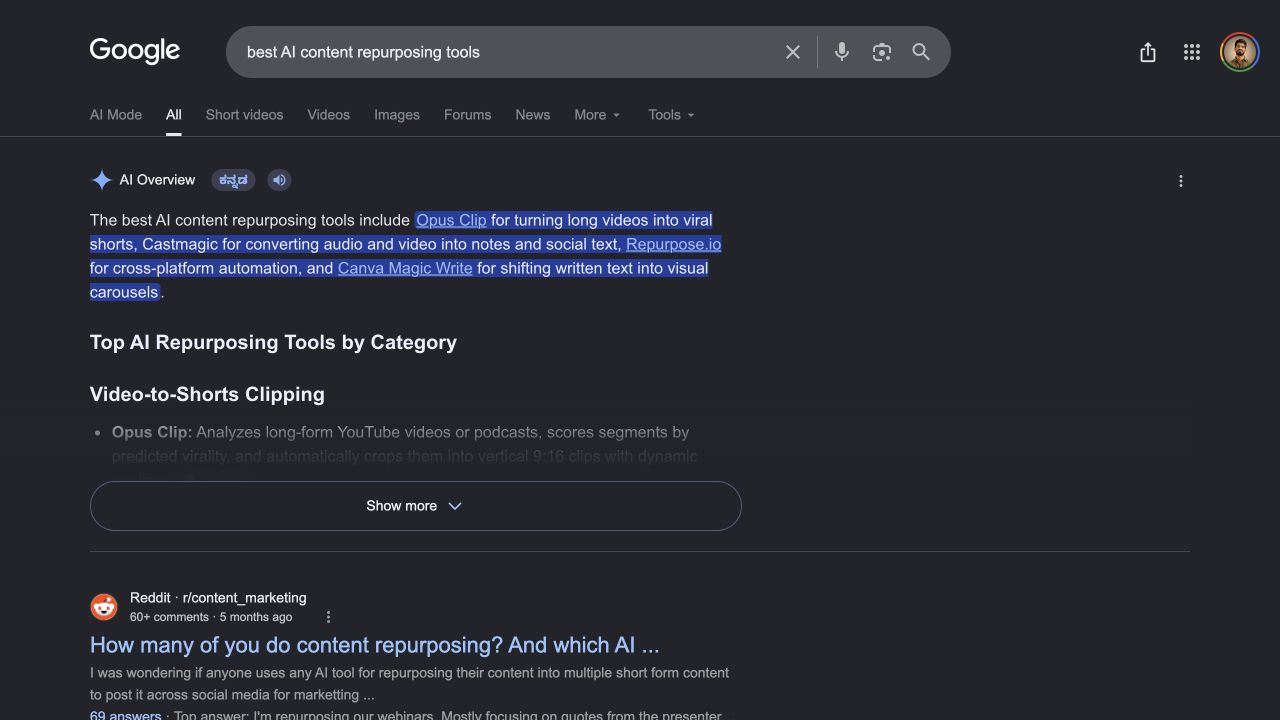
The query returns listicles, product pages and comparison-led results.
Commercial intent exists, but the result set is already crowded.
Signalcut needs a narrow use-case position, not another broad category page. Search results vary by location and time.
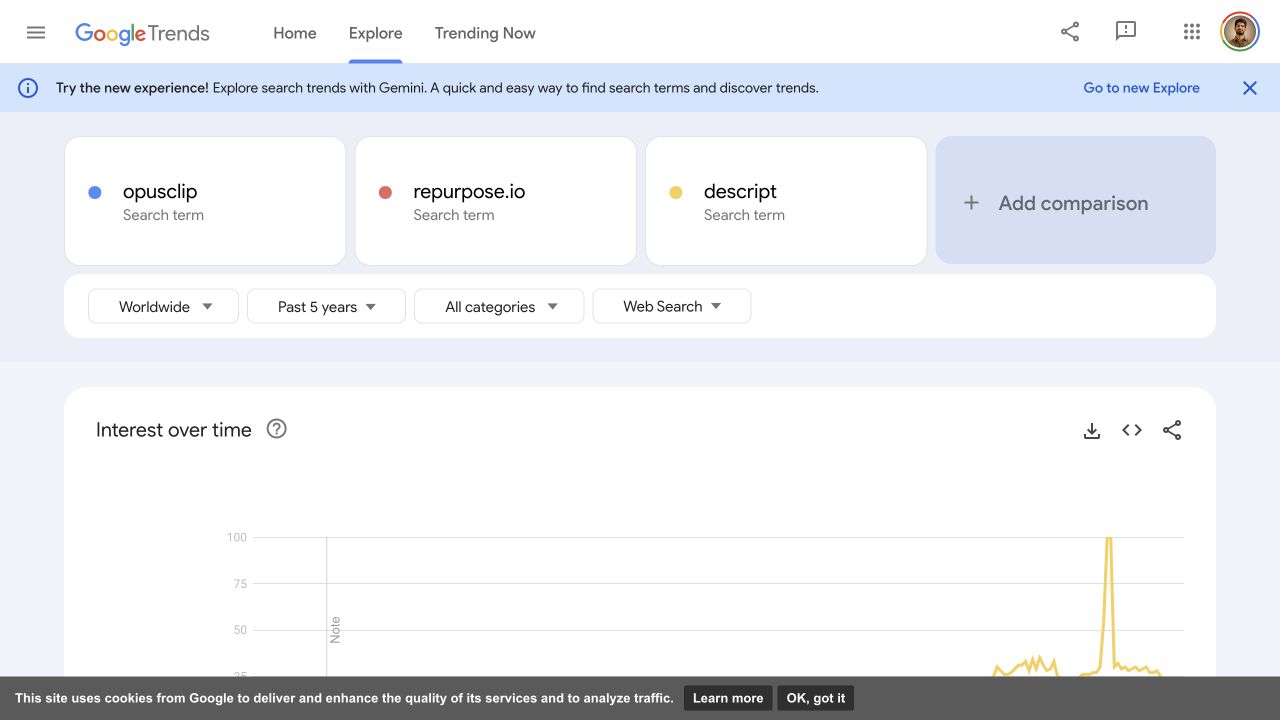
The comparison shows materially different search-interest patterns across three peers.
Brand creation is possible. Demand is not evenly distributed across the category.
A small target should borrow demand before trying to manufacture it. Trends is indexed and relative, not search volume.
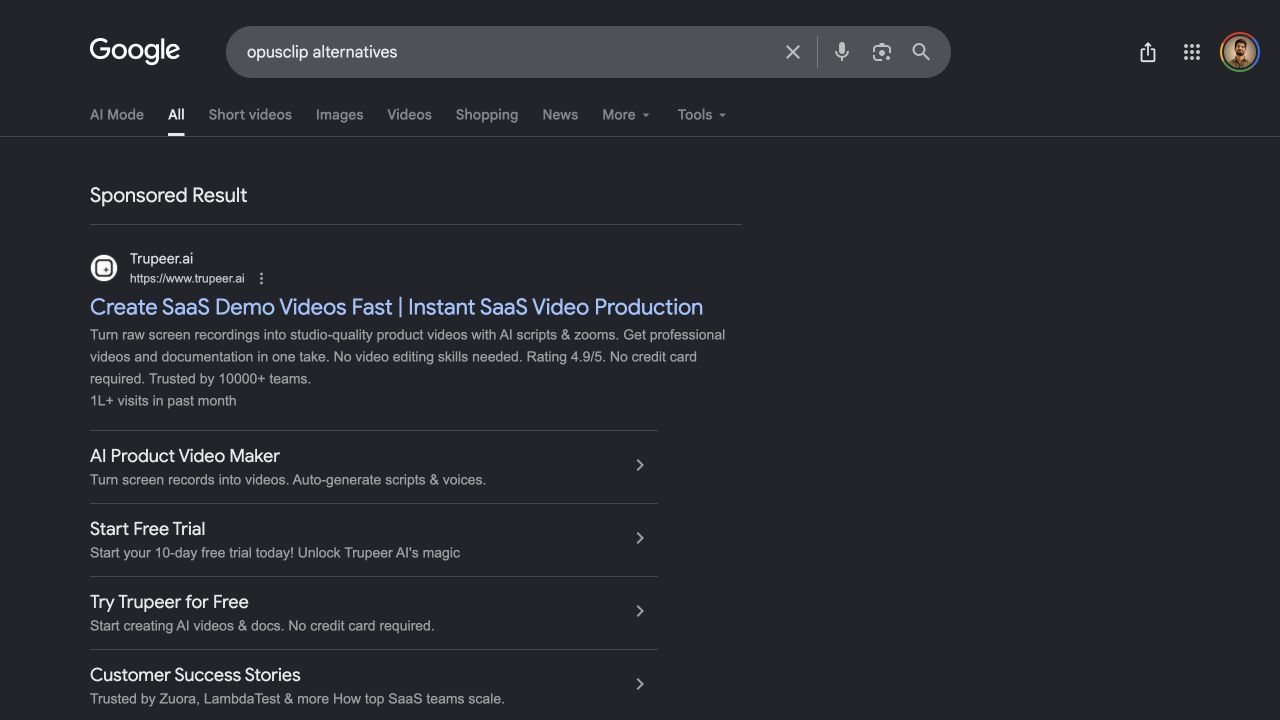
The alternatives SERP contains vendors and third-party comparison pages.
Comparison pages are a credible bottom-funnel entry point.
Signalcut can compete on a specific unmet need without ranking for the whole category. Rankings are volatile and personalised.
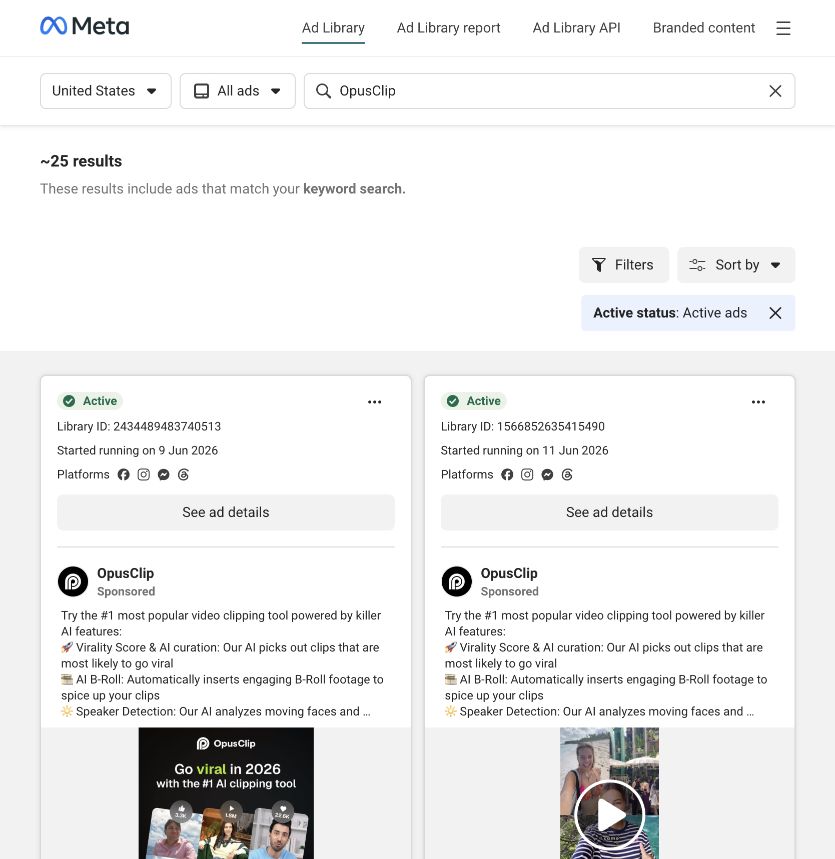
The library showed about 25 matching results and multiple active creatives.
A scaled peer sees enough value to keep testing paid social.
Paid demand is plausible, but Signalcut should not copy spend before fixing activation. A library listing does not reveal spend, CAC or profitability.
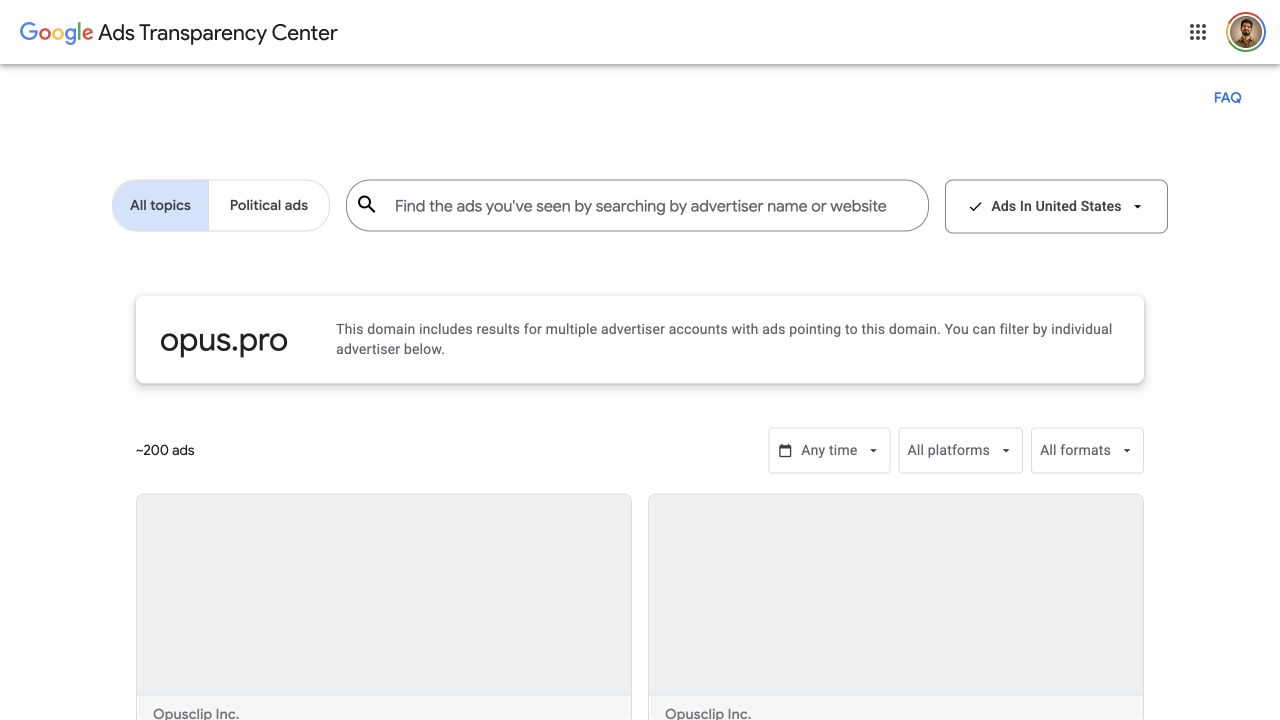
Google's transparency interface provides a public route to current advertiser creative.
Ad-message longevity can be used as a directional proxy for repeatable demand.
Creative claims can inform Signalcut's tightly bounded search test. Availability and completeness vary by advertiser and region.
Output control, editing quality and price are repeated switching triggers.
 Public username obscured
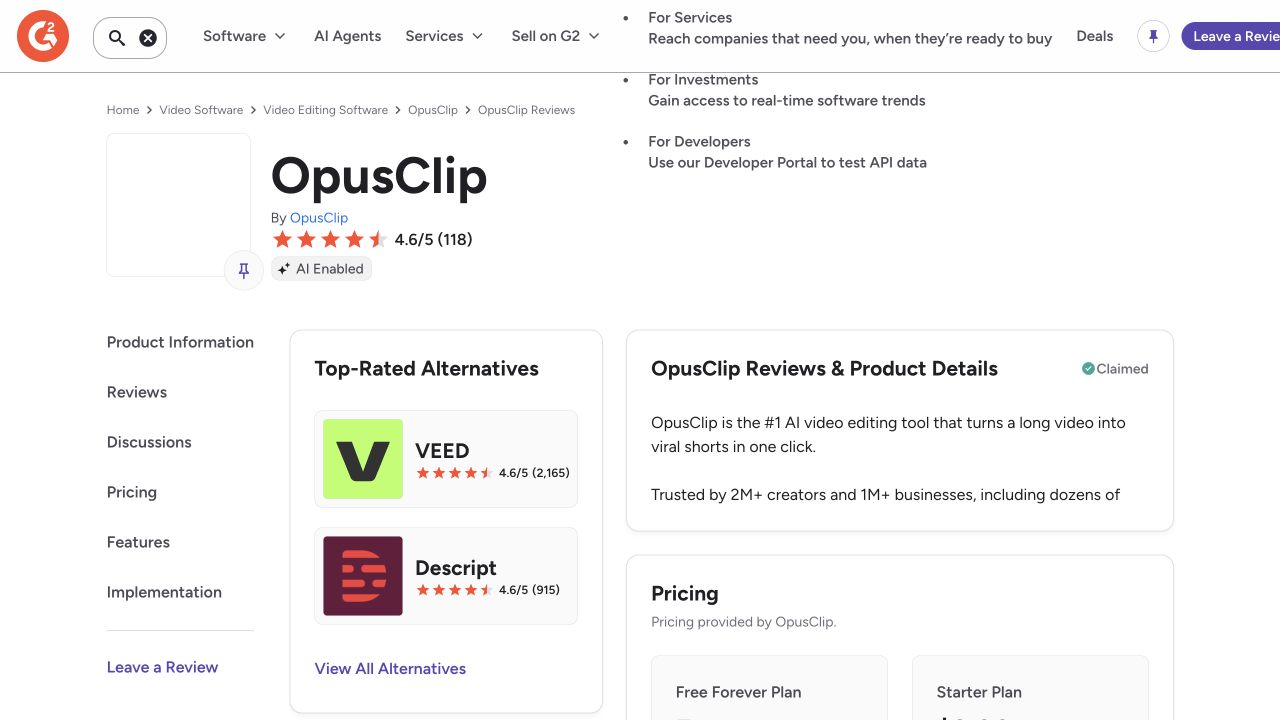
G2 displayed a 4.6 out of 5 rating from 118 reviews and several highly reviewed alternatives.
Category trust is built through large, independent proof sets.
Signalcut's 86-review footprint is useful but not yet a trust moat. Review platforms have selection bias and vendor-led collection.
 Public username obscured
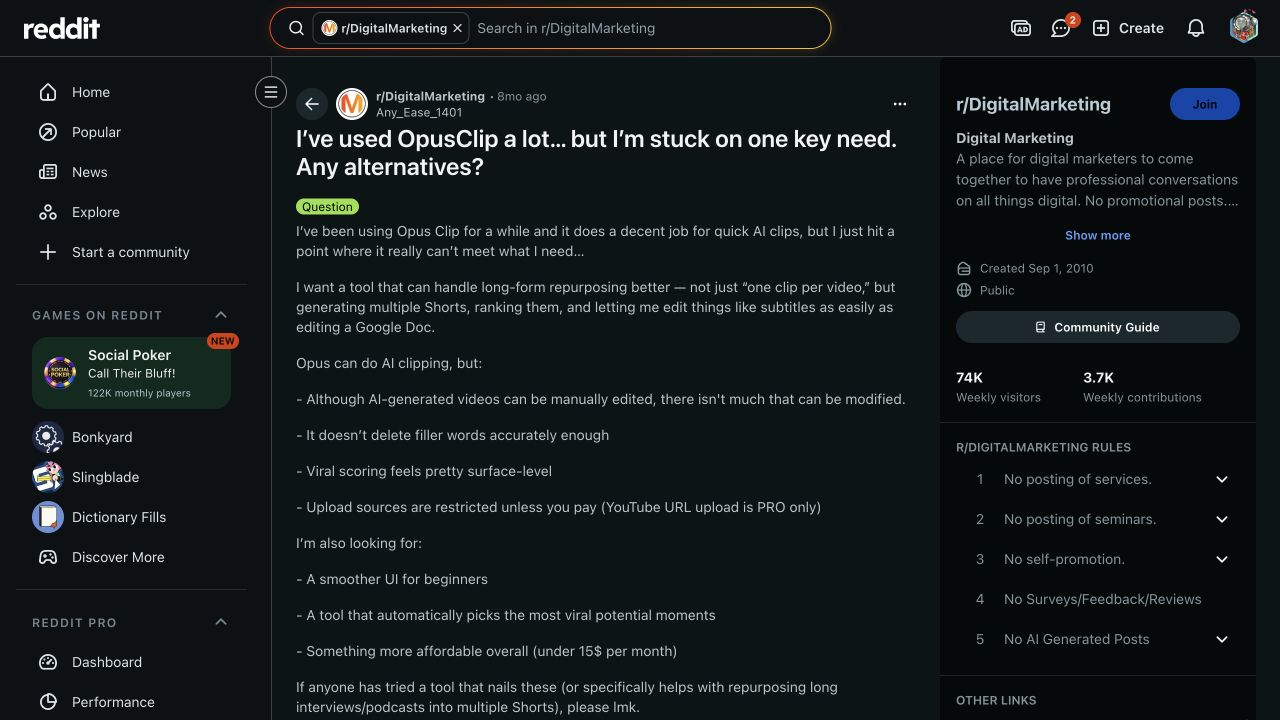
A user asks for better editing, filler-word handling, multi-short workflows and lower pricing.
Output control and affordability are live switching triggers.
These needs should shape Signalcut's activation demo and comparison copy. One discussion is not representative of all buyers.
 Public username obscured
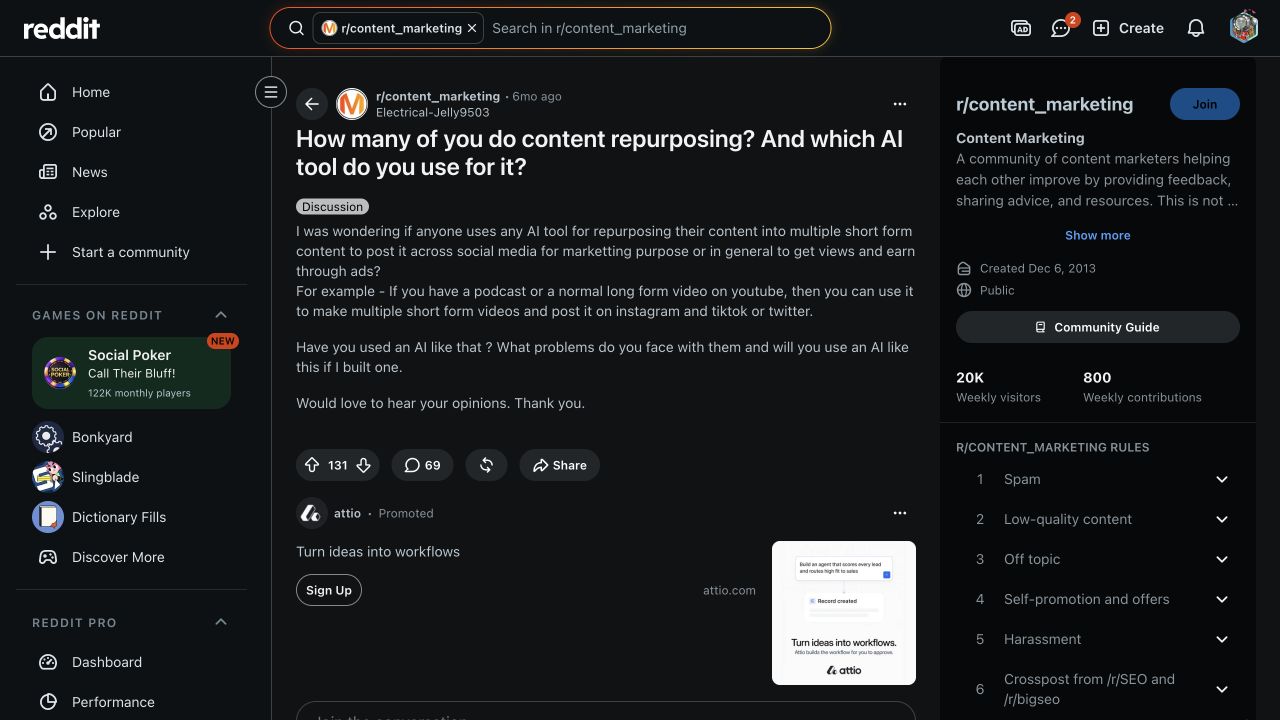
Marketers compare how and whether they repurpose content and which tools they use.
Community education can intercept buyers before they form a shortlist.
Expert participation is a testable channel. Scripted promotion would create trust risk. Community threads can include undisclosed promotion.
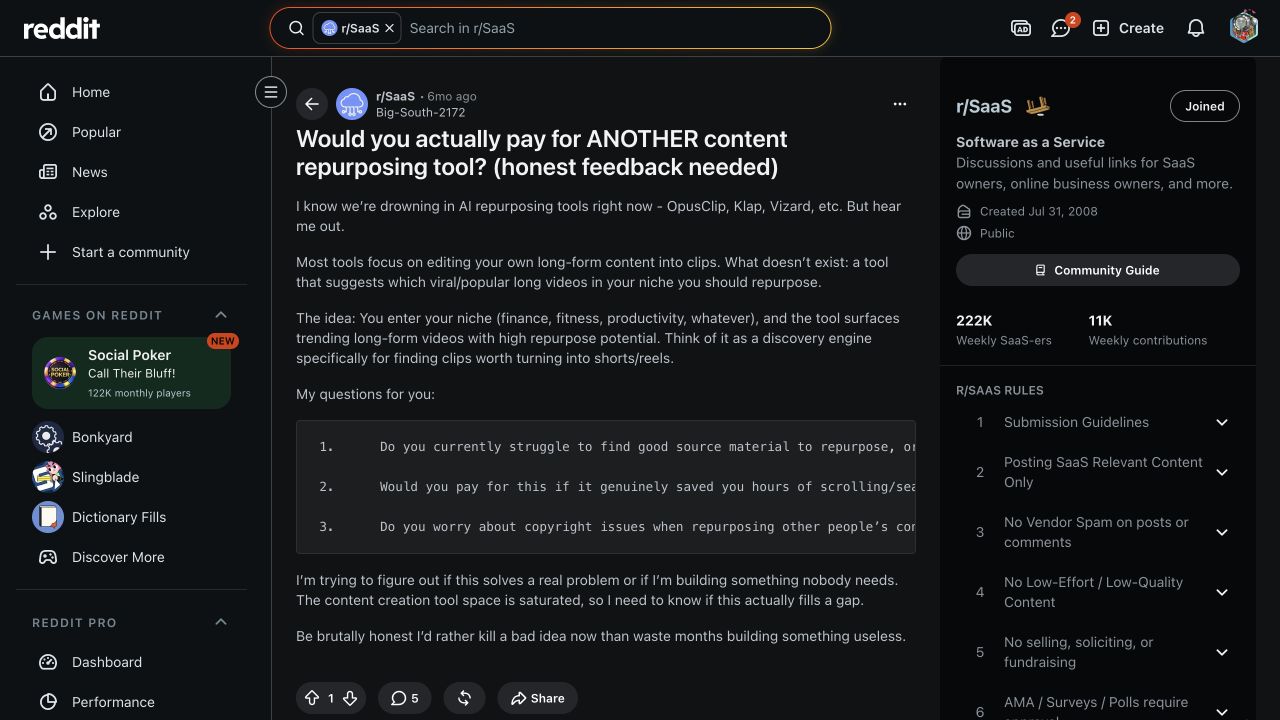 Public username obscured
The thread asks whether buyers would pay for another content tool in an already busy category.
Generic positioning will be discounted before product quality is considered.
Signalcut must own one job and show a visible quality difference. Founder communities skew toward product builders.
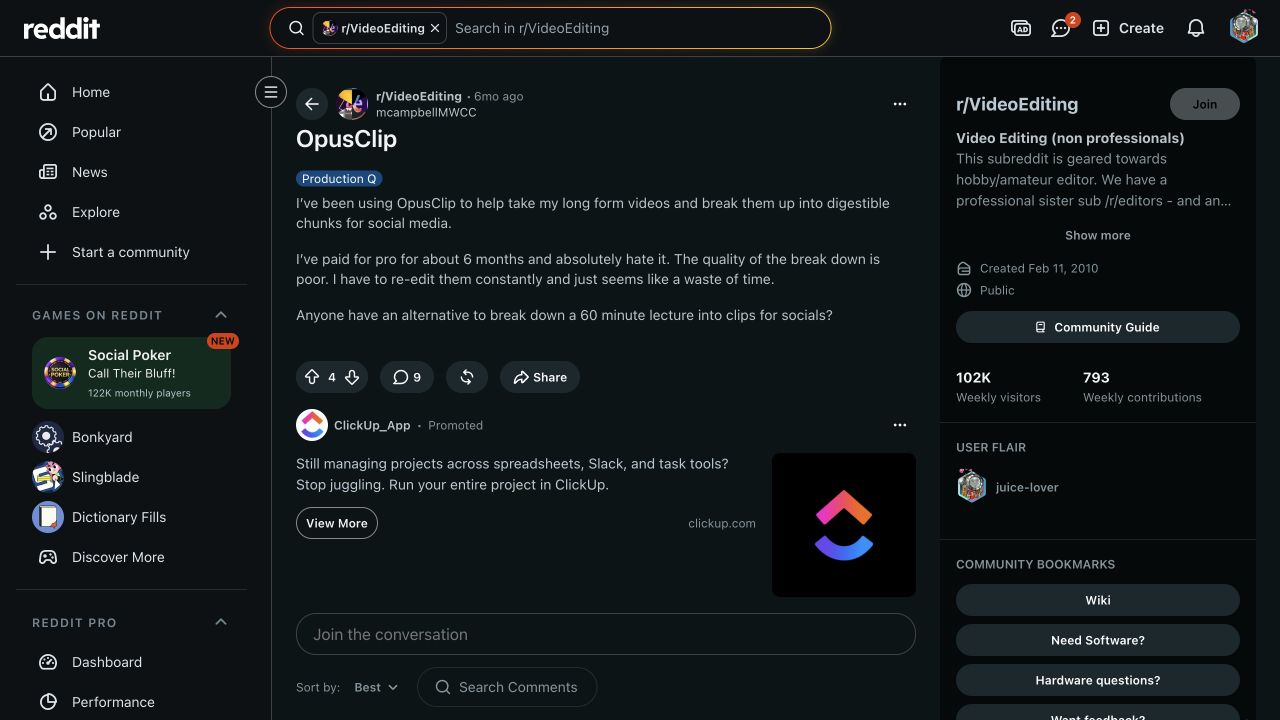 Public username obscured
Editors discuss the reliability and usefulness of automated clip selection.
Trust in the output, not generation speed, is the category's retention battleground.
First-run proof should explain why a recommended output is usable. Professional editors may hold a higher quality bar than the core buyer.
Independent tutorials, launch proof and brand-owned distribution all shape the shortlist.
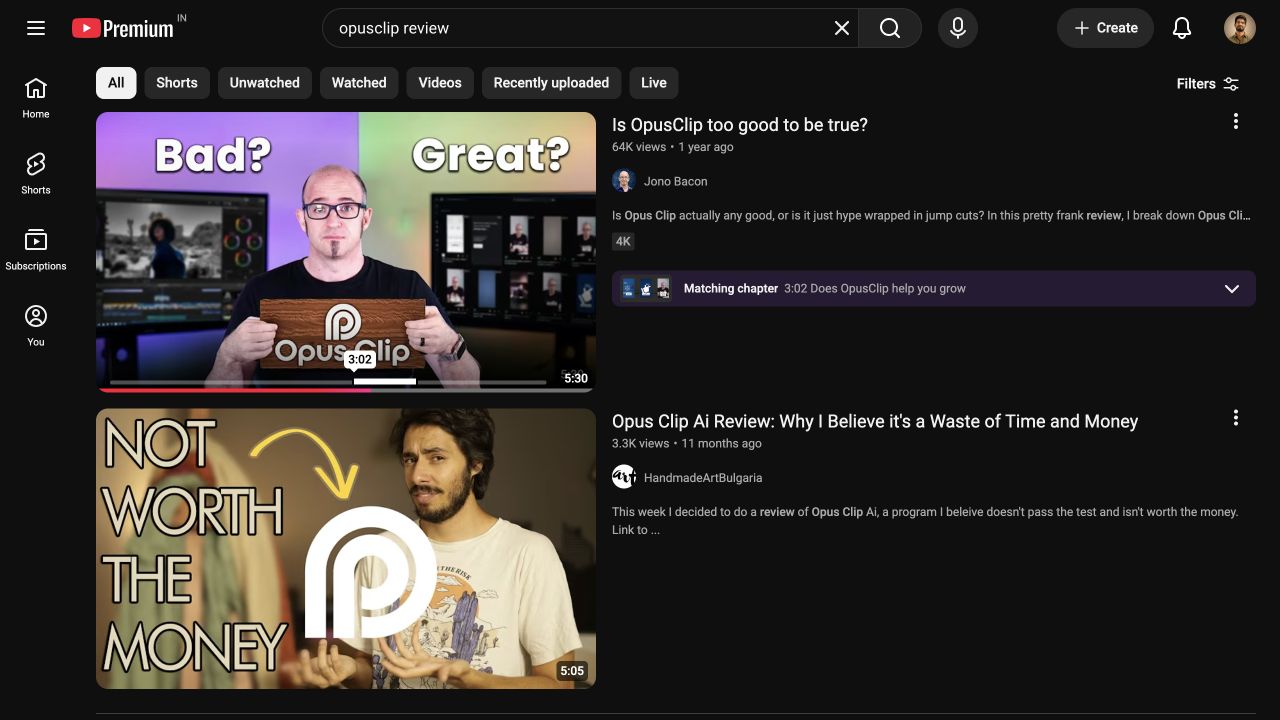
Search surfaces independent reviews with both positive and critical framing.
Tutorial and review demand has longevity and carries stronger trust than brand claims.
A creator test can validate acquisition while building reusable proof. Views and ranking do not prove downstream conversion.

Category searches return tutorials, roundups and workflow content from many creators.
The channel supports both search-led discovery and partner distribution.
Signalcut can start with five small, high-fit creators rather than a large sponsorship. The screenshot is a point-in-time result set.
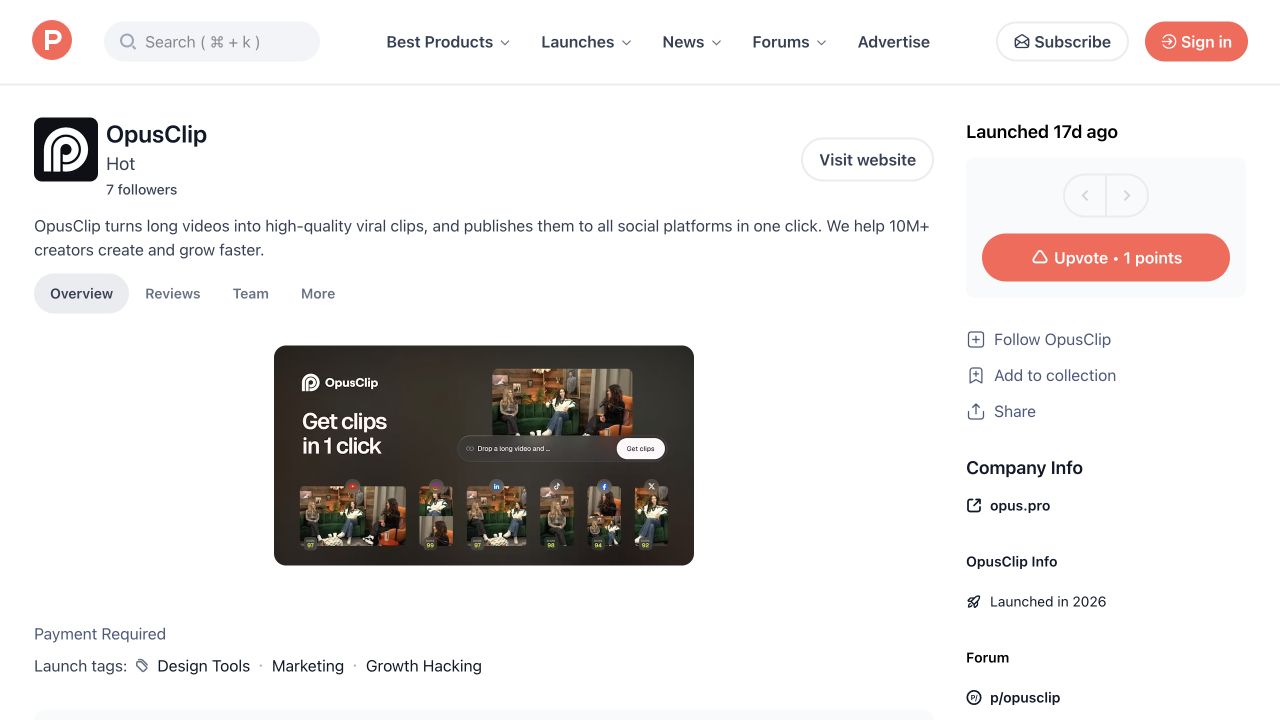
The public product page aggregates launch positioning, community response and product updates.
A relaunch can create a proof asset, but is not a durable channel by itself.
Use a launch after the product story improves, not as a substitute for it. Launch audiences over-index toward technology users.
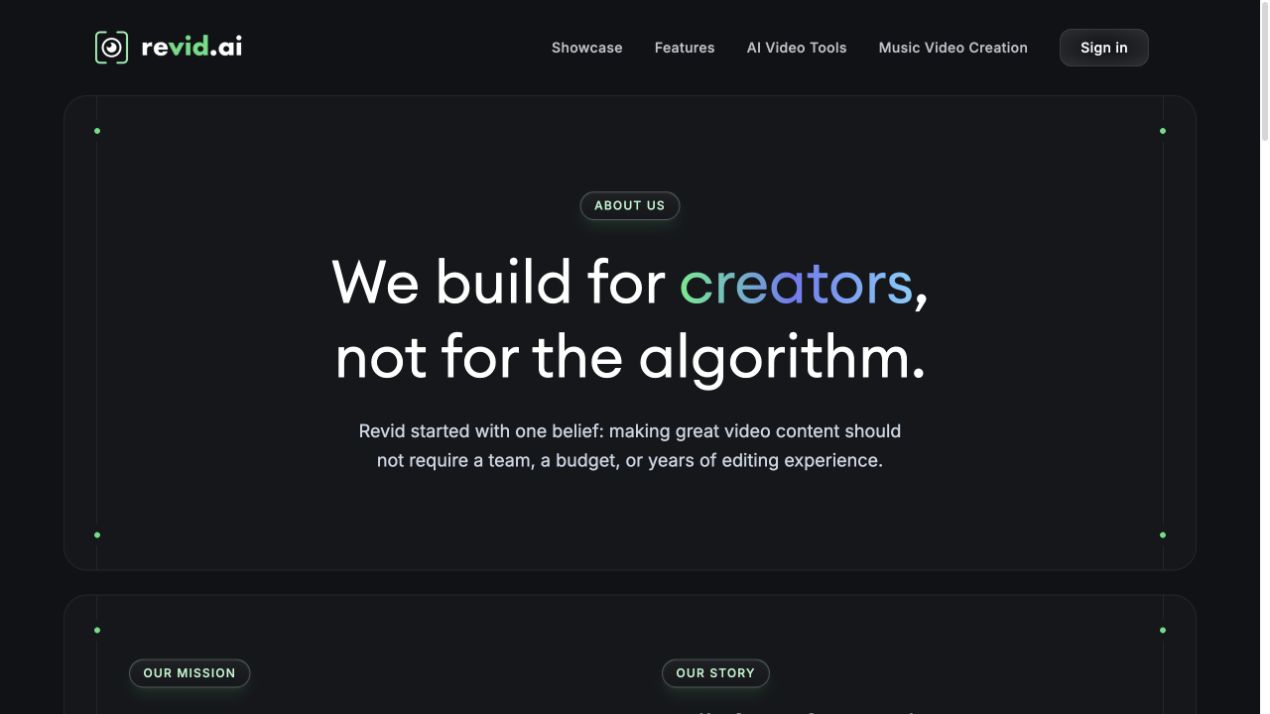
The company gives the founder and product origin a prominent public role.
Founder credibility can accelerate trust, but distribution must become brand-owned before transfer.
Signalcut should turn founder insights into reusable brand formats during transition. An about page does not measure actual founder contribution.
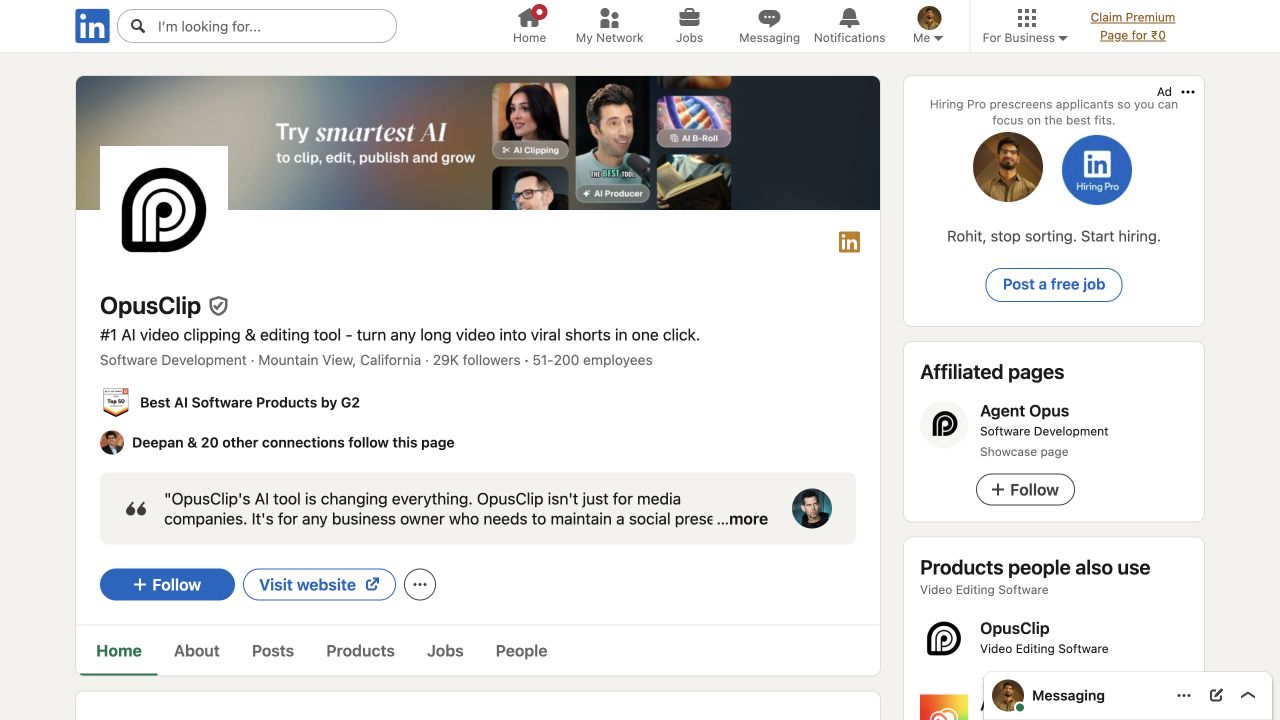
The official company page shows an active brand-owned presence.
Peer distribution is not limited to a founder account.
Signalcut needs recurring formats that survive the founder handoff. Public follower counts and visible posts do not establish audience quality.
Annual billing, usage boundaries and workflow ownership create room above Signalcut’s current ARPA.
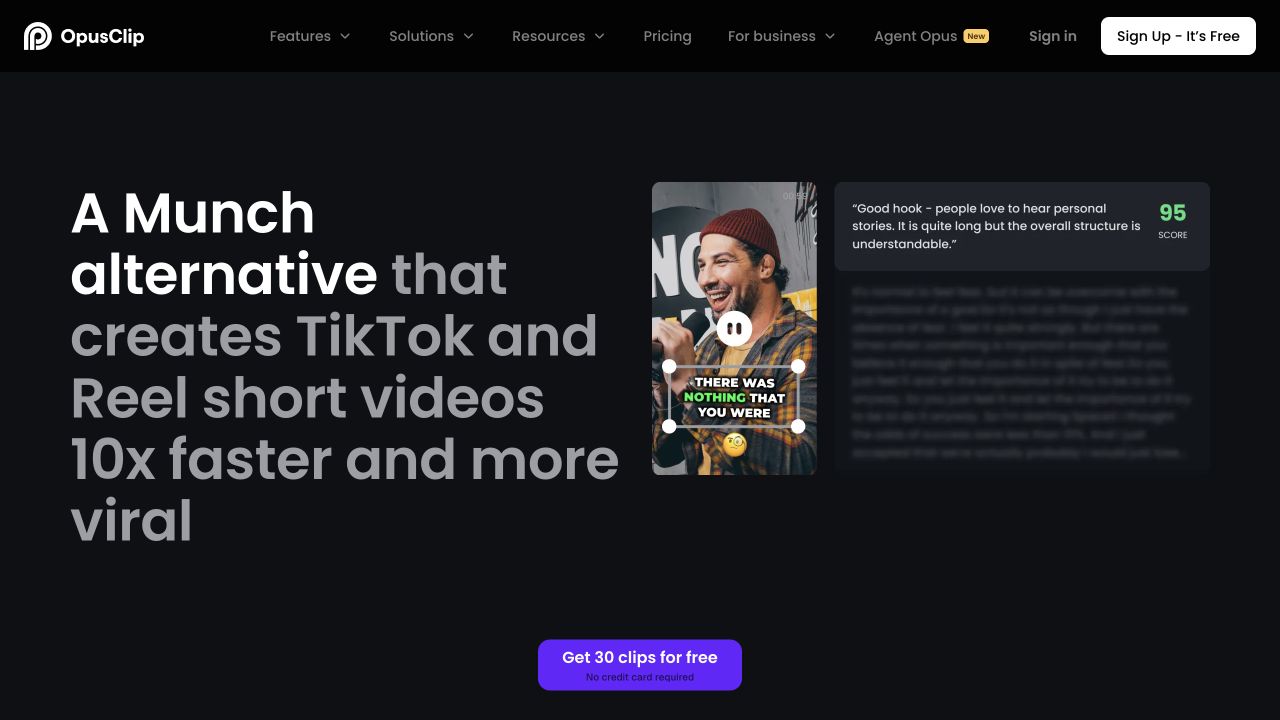
The vendor publishes a dedicated page comparing itself with another tool.
Competitor-led comparison SEO is an accepted acquisition pattern in the category.
Signalcut can build evidence-led pages around precise switching reasons. Vendor comparison claims are inherently selective.
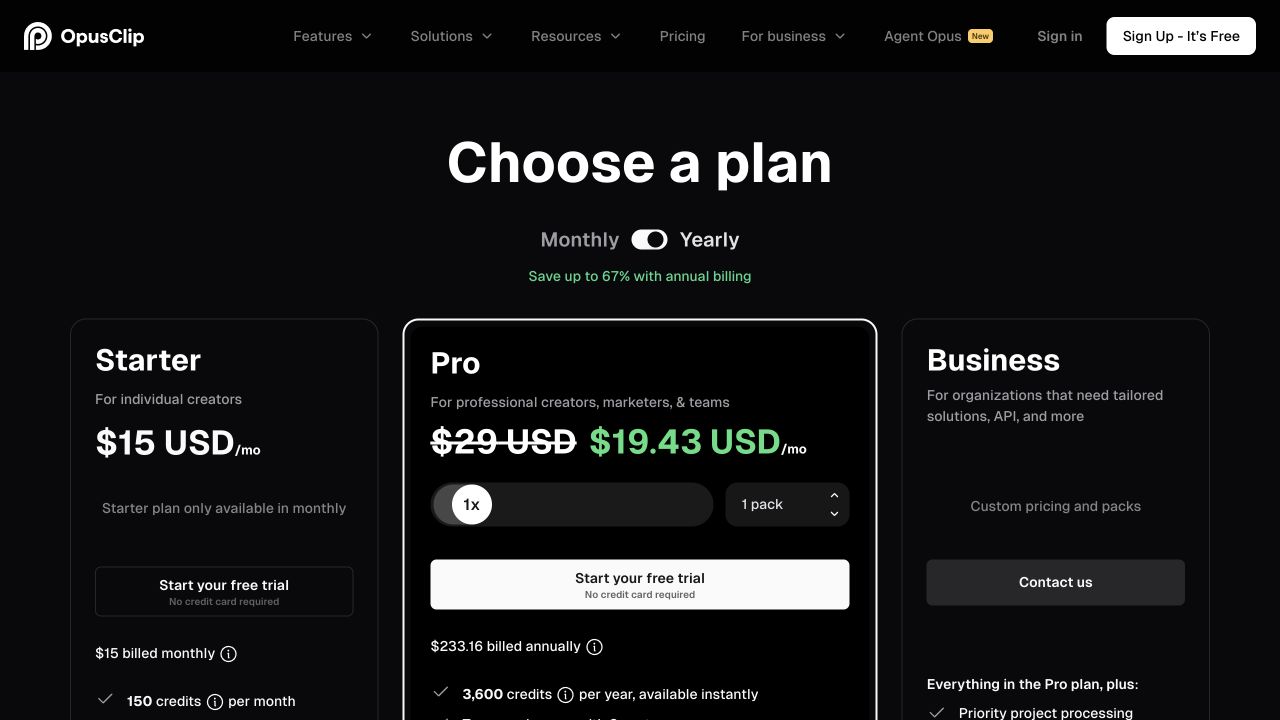
The pricing page exposes monthly and yearly choices with a visible annual incentive.
Signalcut's monthly-only pricing leaves cash flow and commitment on the table.
An annual plan is a low-complexity monetization test. Displayed prices and promotions can change.
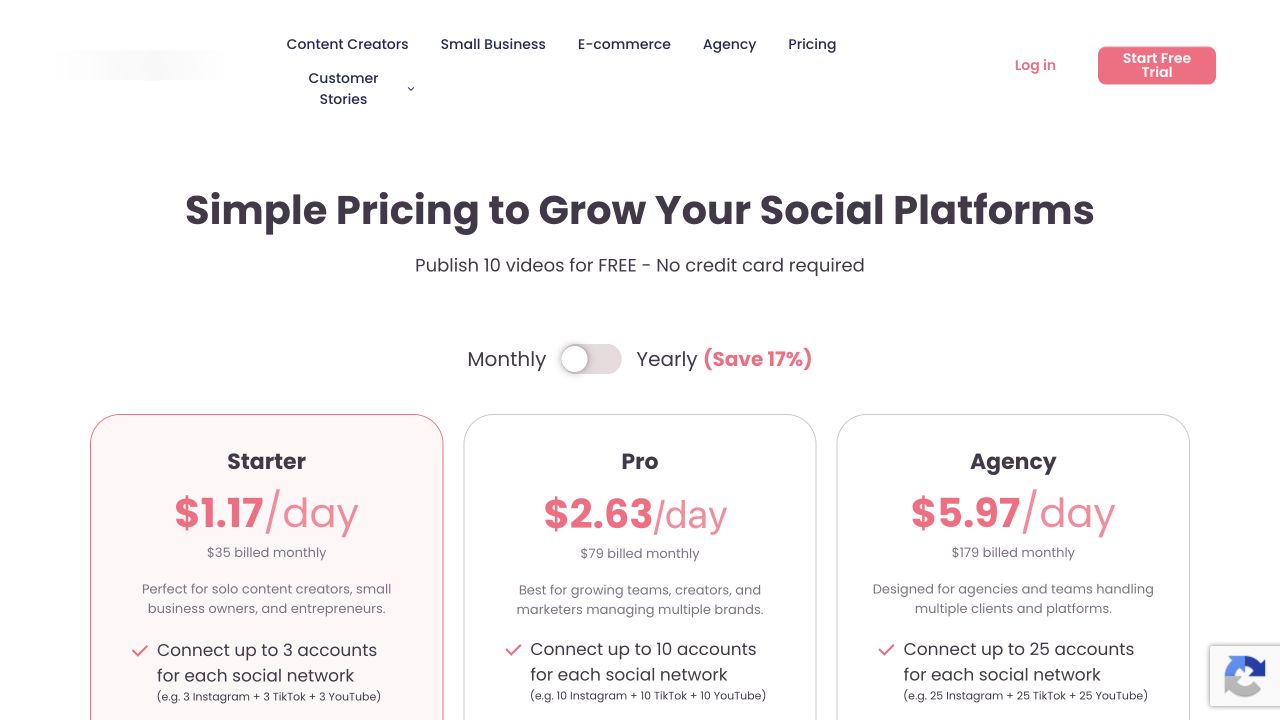
Pricing packages automation as a recurring workflow rather than a single output.
Buyers will pay more when the product owns a repeatable workflow.
Role templates and integrations can support ARPA expansion. Feature breadth and buyer segments are not identical to Signalcut.
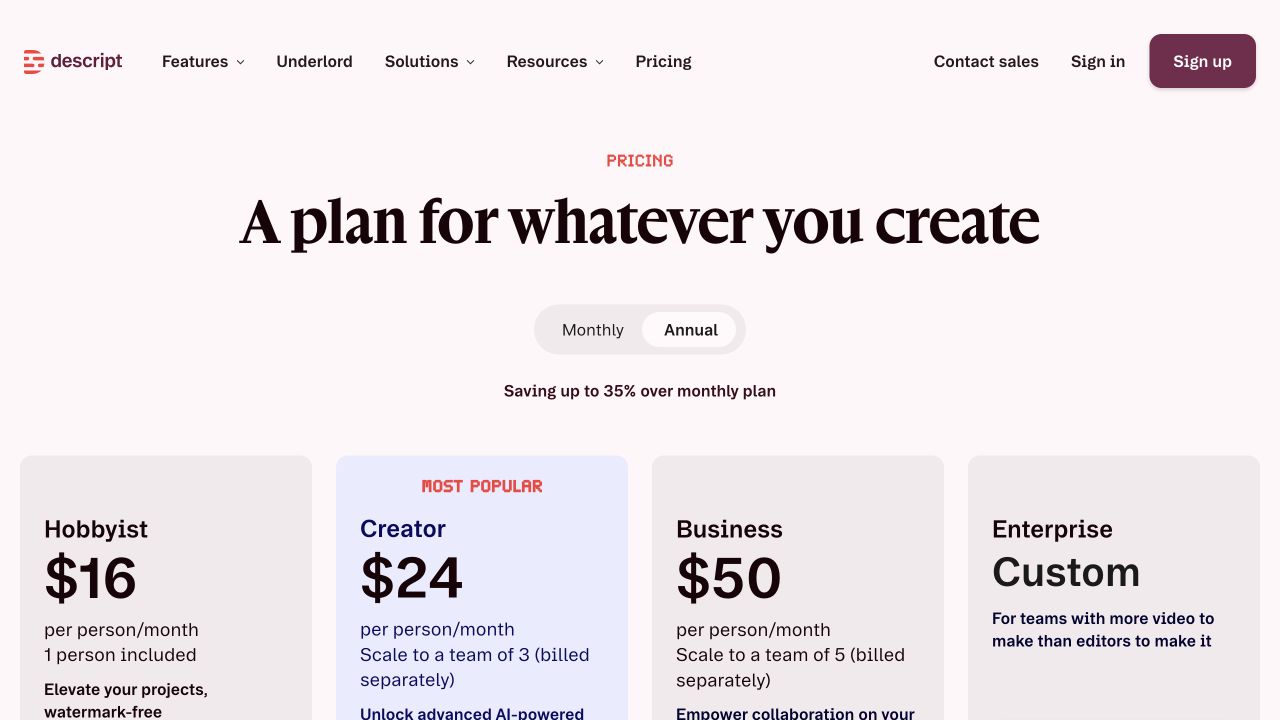
Descript bundles creation and editing capabilities across multiple tiers.
Signalcut should avoid a breadth contest and sell speed to one outcome.
Narrow positioning is more defensible than feature parity at this size. Descript serves a wider market and is not a direct like-for-like peer.

The peer maintains a large, structured educational content library.
Competing on volume is unrealistic. Signalcut should cover high-intent gaps deeply.
Refresh the pages closest to purchase before expanding top-of-funnel content. Library size alone does not establish traffic or conversion.
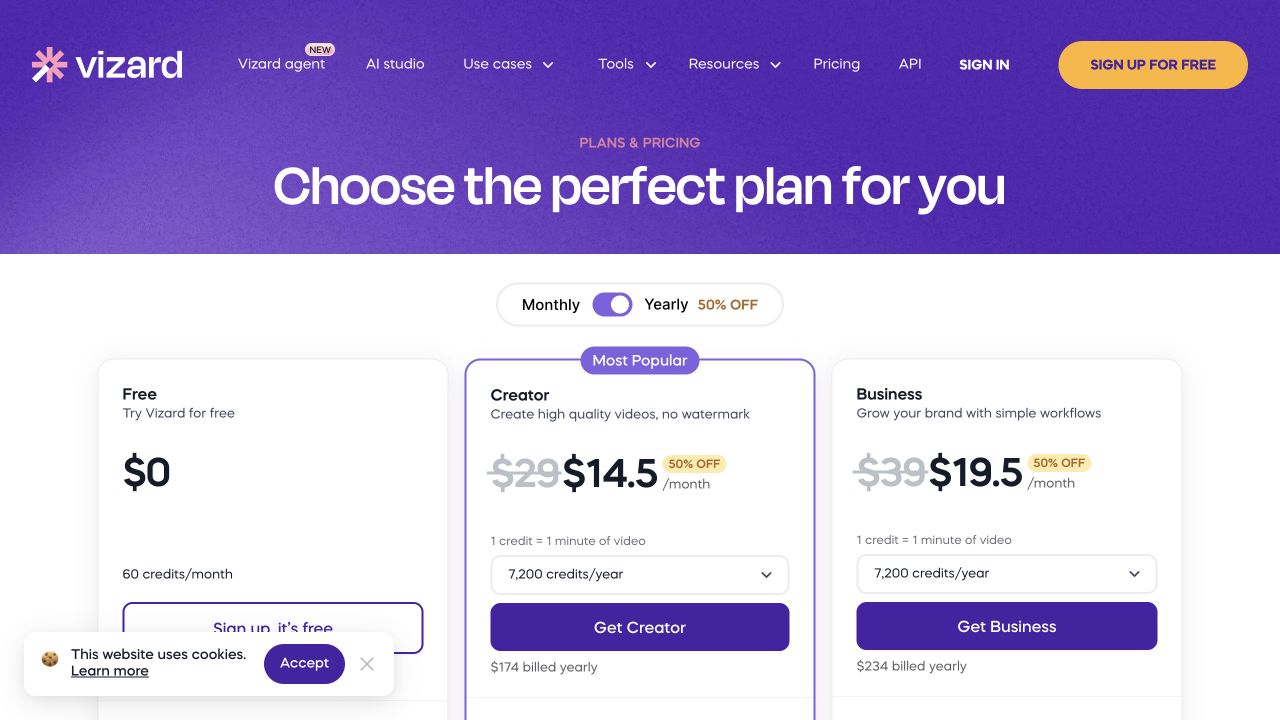
The pricing page uses plan and usage boundaries to segment customers.
Usage packs can monetize episodic demand without forcing a plan jump.
Signalcut can test packs alongside annual plans without rebuilding billing logic. Displayed packaging may change and unit economics differ.
The same buyer prompt produces different rankings, but established peers recur.
View all 240 query runs →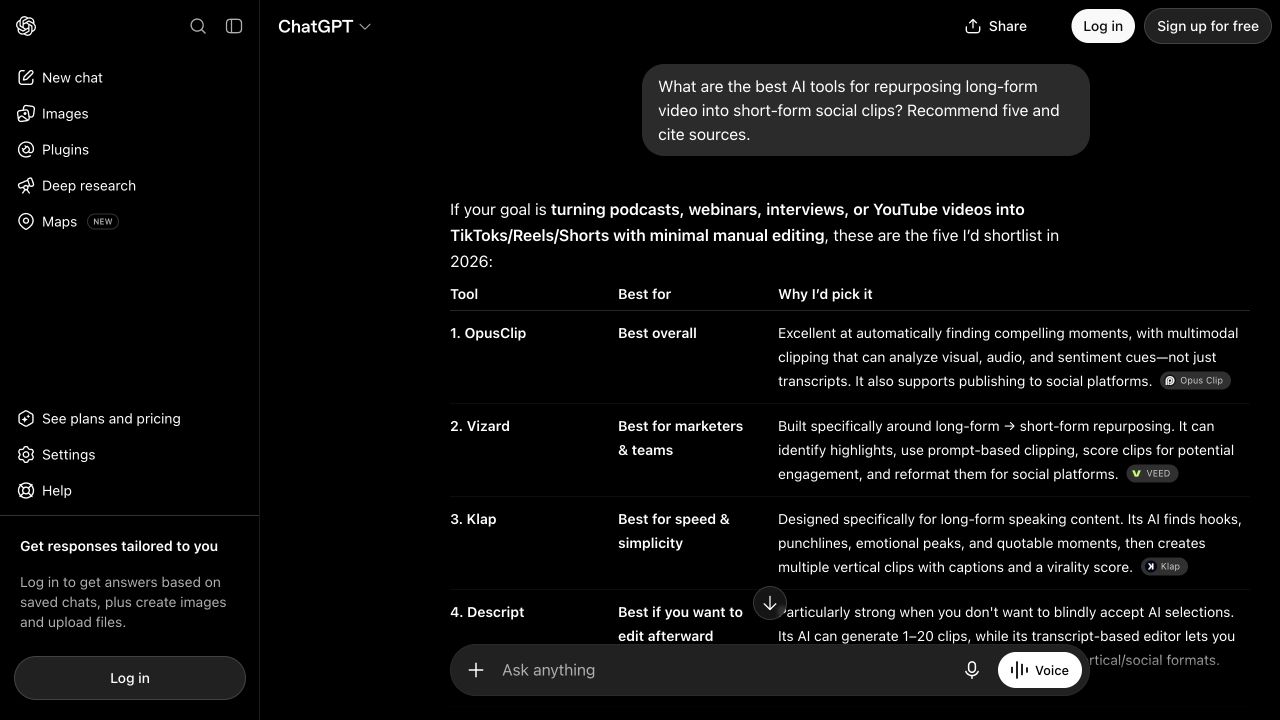
The dated prompt returned OpusClip, Vizard, Klap, Descript and Riverside, with cited sources.
AI discovery concentrates attention around brands with strong public category evidence.
A real target should be tested repeatedly for inclusion, position, sentiment and citation quality. One logged-out prompt is a point-in-time test. Answers can change by model, location and session.
 Account image obscured
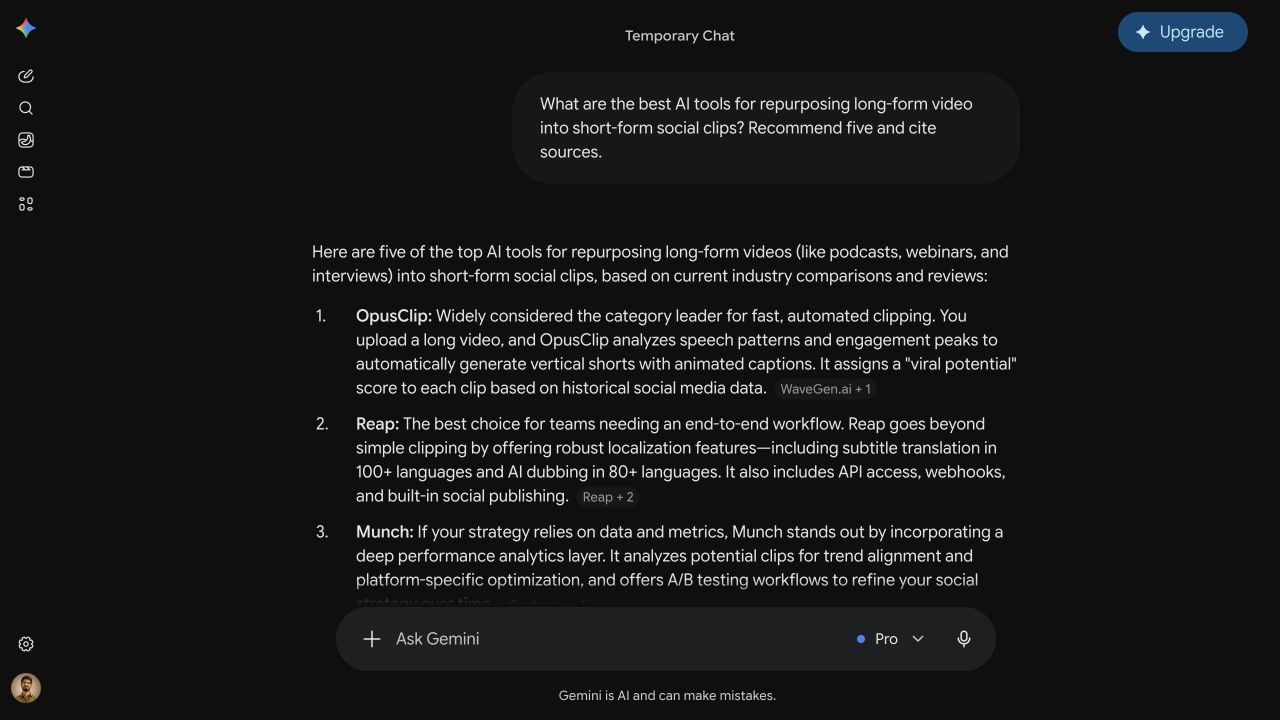
The same prompt returned OpusClip, Reap, Munch, Descript and Klap with inline source chips.
Recommendation position differs by answer engine, but established peer brands recur.
Prompt stability and source coverage should be tracked before treating AI discovery as a channel. A single temporary-chat response is not a visibility trend and the fictional target cannot be independently tested.
Access limitations: Claude required sign-in. TikTok Creative Center, Wayback Machine and PageSpeed blocked public capture. No substitute image was used.
Signalcut is the smallest business in this peer set: $49,800 trailing 12-month revenue, 214 paying accounts and $19.60 ARPA.
Private-company revenue is not disclosed. These are third-party estimates or annualized founder claims, not audited comparables. Revenue confidence is low across all rows.
| Competitor | Estimated annual revenue | Position and pricing | Scale signal | What it means for Signalcut |
|---|---|---|---|---|
| Descript ↗Adjacent suite | $55m ARRSacra estimate for late 2024Sacra source ↗Confidence: Low | Broad audio and video editor with transcription, recording and generative tools. $16–$35 per person / month ↗ | $100m reported funding with a hybrid seat and AI-credit model. | A category ceiling and budget anchor. This is not a feature set Signalcut should try to match. |
| OpusClip ↗Direct | $10.3m revenueLatka estimate for 2025GetLatka source ↗Confidence: Low | AI clipping and editing for creators, marketers and teams. $15–$29 / month + business ↗ | 10m+ creators claimed. $36.8m funding reported. | The broad head-on position is expensive because paid reach, authority and enterprise trust are already funded. |
| revid.ai ↗Adjacent suite | $7.2m–$8.2m annualizedFounder-claimed $600k–$680k MRR, annualizedARR Founder source ↗Confidence: Low | Turns ideas, text, links and recordings into finished short-form videos. $39–$199 / month ↗ | 14,000+ creators claimed. The affiliate program is a core distribution loop. | The larger opportunity may sit beyond clipping, but the revenue claim needs direct verification before use as a valuation comp. |
| Repurpose.io ↗Direct | $5m revenueLatka estimate for 2024GetLatka source ↗Confidence: Low | Workflow automation that republishes content across social platforms. $35–$179 / month ↗ | Bootstrapped with an 11-person team estimated by Latka. | Recurring distribution workflows and integrations can support materially higher ARPA than a one-off generation tool. |
| Vizard ↗Direct | $2.1m revenueProspeo company-model estimateProspeo source ↗Confidence: Low | Long-form-to-short-form editing for content and social marketers. Free + paid credit tiers ↗ | 40,000 users and 21–50 employees estimated by Prospeo. | This is the closest scaled product proxy. Signalcut needs a sharper use case and faster activation, not parity. |
| Klap ↗Direct | $440k revenue2026 third-party case studyPassionbits source ↗Confidence: Low | Turns long videos into captioned, reframed vertical clips. $29–$189 / month ↗ | 1.5m creators and 9.3m clips claimed. A four-person team is reported. | This is the relevant lean benchmark. Creator-led distribution can outscale the brand account, but user count alone says little about paid depth. |
Our read. The category supports meaningful businesses, but direct rivals already range from roughly $0.4m to more than $10m in estimated annual revenue. Signalcut cannot win on breadth. Its plausible position is one narrow workflow with faster first value, stronger output trust and integrations that make the job recur.
What we observedSearch drives 52% of reconstructed acquisition. Ten pages receive 58% of organic visits.
Compared withSeller labels 73% of acquisition as organic. Public SERPs show established buyer-intent demand and heavy competition.
What it meansSignalcut has an asset, but it is smaller and more concentrated than the seller framing suggests. A small ranking loss can erase a meaningful share of new accounts.
Do nextExport landing-page revenue and refresh the five highest-intent pages first.
What we observedA $5.20 modeled CPC and the observed funnel imply a $240–$360 CAC.
Compared withThe closest LocaliQ paid-search benchmark is $5.87 CPC. Modeled gross-profit LTV is about $260 at cohort churn.
What it meansTraffic is purchasable, but scaling now would convert funnel leakage into cash burn. Paid spend should be a diagnostic test, not a growth plan.
Do nextSpend only after activation reaches 38% and trial-to-paid reaches 21%.
What we observedThe founder account drives 61% of meaningful social interactions. Company-page engagement is 0.42%.
Compared withPeers maintain brand-owned distribution and founder narratives in parallel.
What it meansThe audience is useful, but part of the acquisition asset leaves with the seller. The eight-hour workload claim understates transition risk.
Do nextConvert the ten best founder posts into named brand series during a 60-day handoff.
What we observedPeer review queries surface durable, independent videos with positive and critical framing.
Compared withSignalcut has no independent tutorial ranking for its highest-intent query set.
What it meansThe absence is a practical distribution gap, not proof the channel will work. A small creator test can produce traffic, proof and reusable sales material at once.
Do nextFund five workflow videos. Stop if 150 qualified visits produce fewer than six activations.
What we observedPublic discussions repeat editing control, output quality, affordability and workflow-fit concerns.
Compared withSignalcut has 86 reviews at 4.4. A scaled peer shows 118 at 4.6 on G2.
What it meansTrust exists, but recurring category objections likely map to churn and deserve product treatment. More review volume will not help if output complaints remain unresolved.
Do nextTag support and cancellation reasons. Resolve the top output complaint before requesting reviews.
What we observedThe target appeared in four of 15 dated category prompts. The peer median was eight.
Compared withIncluded brands had clearer third-party citations, comparison pages and category authority.
What it meansVisibility is weak, but improvable through evidence others can cite. A growing discovery surface is currently sending shortlists elsewhere.
Do nextPublish original workflow research and secure three independent citations before re-testing prompts.
What we observed31% activate, 17% of trials pay and cohort-derived monthly churn is 5.6% versus the seller's 3.4%.
Compared withAt 3.4% the implied customer life is 29 months. At 5.6% it is 18 months.
What it meansRetention is the central unresolved fact and current acquisition payback is fragile. A two-point churn error materially overstates LTV and fair value.
Do nextRebuild cohorts from Stripe customer records before signing.
What we observedMedian first output takes 7m 40s. Activation is 31%. LCP is 3.4s while INP and CLS are within good thresholds.
Compared withGoogle defines good LCP as 2.5s or less. Public criticism centers on confidence in automated outputs.
What it meansThe main issue is not a redesign. It is a clearer path to a trusted first result. Improving first value can lift paid conversion and reduce early churn together.
Do nextBuild one guided source-to-approved-output journey and explain why each output works.
What we observedSignalcut sells $19 and $39 monthly plans with no annual option or usage packs.
Compared withPublic peers use annual discounts, higher workflow tiers and usage boundaries.
What it meansAnnual billing and packs are credible tests. A broad price rise is not yet supported. Better packaging can improve cash collection and ARPA without new traffic.
Do nextLaunch annual plans and a small usage pack. Measure mix, refunds and support load.
What we observedPeers compete through broad suites, integrations, content libraries, ads, reviews and launch proof.
Compared withSignalcut has fewer features and less authority, but faster time-to-output for one creator workflow.
What it meansFeature breadth is unwinnable at this scale. A narrow workflow can still be defended. The product remains replaceable until workflow data, templates and trust compound.
Do nextOwn one job-to-be-done and add the three integrations that make it recurring.
What we observed$92,000 equals 4.0× seller-adjusted operating profit and 1.85× trailing 12-month revenue. Normalized current EBITDA is $17,800 after essential owner replacement.
Compared withAcquire.com reports a 3.9× median confirmed SaaS profit multiple for 2025 and 3.7× below $100,000. FE International says small, owner-operated SaaS is normally anchored to SDE rather than large-company EBITDA or ARR multiples.
What it meansCurrent earnings, implied revenue and forward EBITDA methods converge on $72,000–$82,000 after explicit operating and execution assumptions. Paying the ask leaves little margin for the three largest diligence gaps.
Do nextOffer within range or bridge the gap with retention-based holdback.
Usable, but not yet confidence-building. The largest gaps sit where a new user chooses a path, judges an AI output and decides whether to pay.
ObservedThe homepage explains content repurposing, but gives four workflows equal weight and does not identify the best first use case.
ChangeLead with one creator-to-short-form outcome and show the finished result beside the primary CTA.
ObservedThe primary action is visible, but examples, proof and pricing compete at similar emphasis below the fold.
ChangeSequence the page as promise, proof, example, then price. Demote secondary navigation and feature detail.
ObservedA new trial meets six setup choices before a recommended path. Only 31% reach the activation event.
ChangeDefault to one guided source-to-approved-output journey and defer advanced settings until after first value.
ObservedMedian first output is 7m 40s, inside the ten-minute target, but import and format choices delay the first preview.
ChangeGenerate a useful default preview first, then let the user refine format and channel settings.
ObservedThe product presents a result without explaining why it selected or rewrote key moments. Category complaints repeatedly mention control.
ChangeShow before-and-after context, editable rationale and confidence cues beside every generated recommendation.
ObservedProcessing progress is visible, but a failed job returns a generic retry state and does not preserve the user’s last step.
ChangePreserve inputs, name the failure, estimate recovery time and offer the next safe action.
ObservedCore actions are keyboard reachable and the mobile flow works, but muted copy and several tap targets fall below the audit standard.
ChangeRaise text contrast, enforce 44px touch targets and add visible focus treatment to every interactive control.
ObservedThe upgrade prompt can appear before an approved output. Cancellation records no reason and offers neither pause nor a relevant save path.
ChangeAsk for payment at a useful limit, then add cancellation reasons, pause and behavior-specific save offers.
Current conversion leaves too much value between a visit, the first usable output and a retained customer.
Current is observed. Target is the minimum 8-week operating gate before increasing paid spend. It is not an industry benchmark.
No additional traffic is assumed. The target case applies the four operating gates above.
Current18,400
Target18,400
Traffic held flatCurrent791
Target957
+166Current245
Target364
+119Current134
Target201
+67Current113
Target177
+64Broad promise
One job-to-be-done and a real output before signupToo many choices
One guided source-to-publishable-output journeyOutput trust
Before/after proof and a reason for each recommendationPrompt arrives early
Ask at a useful limit. Move team setup after valueOutput and billing complaints
Behavioral lifecycle, pause, save offer and reactivationAlternative queries show buying intent
Independent reviews rank and carry trust
A successful output is naturally shareable
Peers monetize recurring workflow ownership
Buyers surface precise objections in public
Citations appear to influence inclusion
Creator-marketing niches match the job
Peers advertise and category CPC is known
Verified customer cohorts and per-job costs will reset LTV and valuation.
One guided outcome can move activation from 31% to at least 38%.
Packaging can improve cash collection and ARPA without more traffic.
Specific switching pages can diversify a concentrated organic base.
Independent workflow proof can acquire customers and reduce trust friction.
Resolved complaints and citable research will improve shortlist visibility.
Better activation and retention can turn known search demand into acceptable CAC.
Payback Not applicable
Payback 5–7 months
Payback 3–5 months
5.6%$5.7k MRR
4.6%$6.7k MRR
3.8%$8.1k MRR
31%$5.9k MRR
38%$6.7k MRR
42%$7.3k MRR
$19.60$6.2k MRR
$21$6.7k MRR
$22.50$7.2k MRR
Search spend comes last.
Onboarding + conversion$1,500
Creator tutorials$1,500
High-intent search$1,000
Bottom-funnel content$750
Instrumentation$250
It changes LTV, payback and fair value.
Gross margin may be overstated.
Audience and support transferability are not proven.
Traffic attribution is broader than revenue attribution.
The product's IP must transfer cleanly.